PERSONAL PROJECT
REQUIREMNTS
Making Time


BUILDING THE MECHANISM
I worked from David Swan's Construction Guide to Medieval Woodenworks Clocks, using its escapement and drive-train geometry as the basis for the mechanism. Swan's original train was configured for one revolution per hour. To make the clock complete one cycle every twenty-four hours without adding another shaft, I redesigned the tooth and pin counts across the train. Doing so meant understanding how each gear stage multiplied speed, reduced torque, and ultimately governed the interval of the verge swing. These were mechanical decisions, but they also determined the temporal rhythm the object would produce.
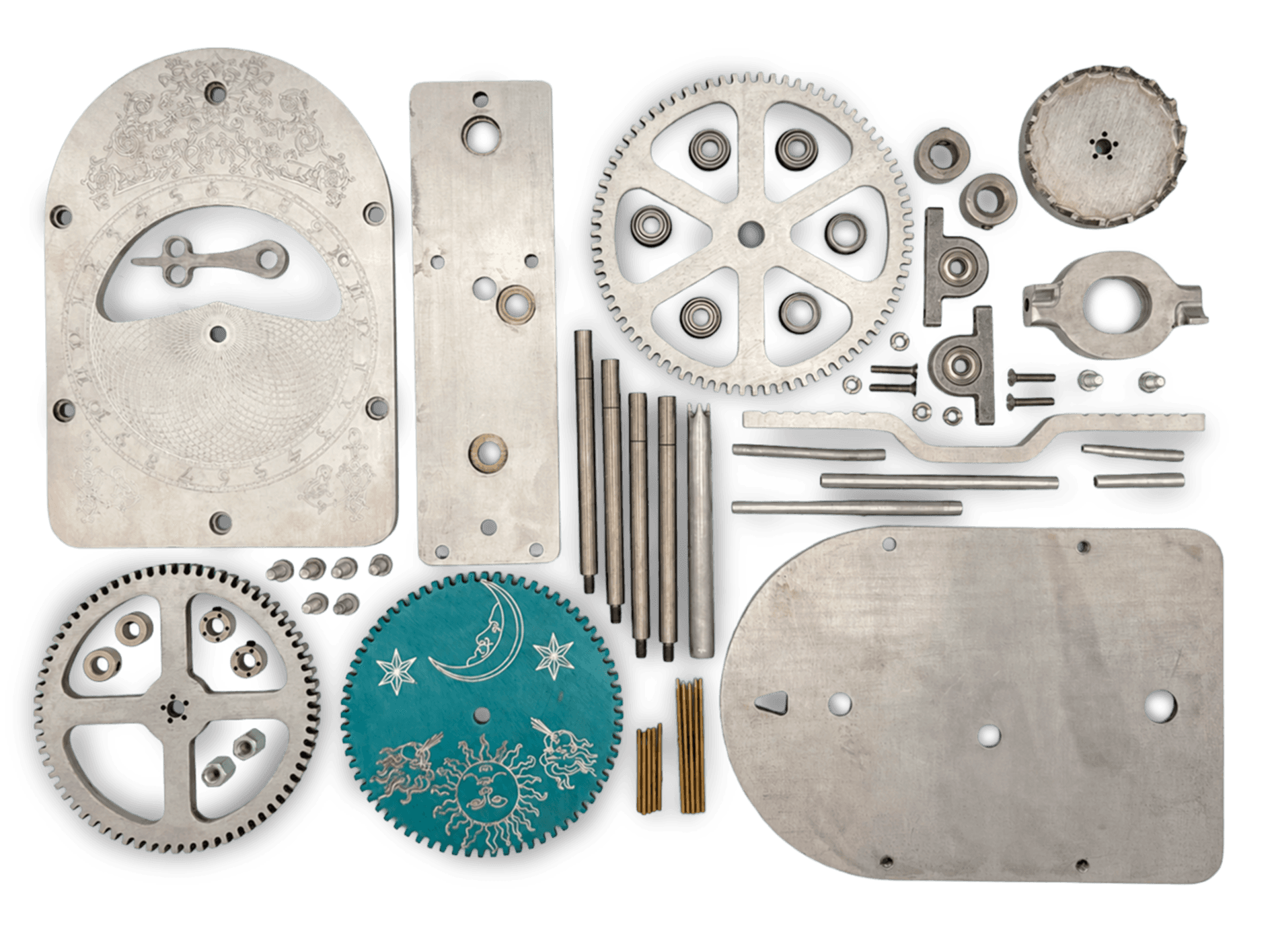
I milled the wheels, verge, foliot, frame plates, and pinion carriers from aluminum and pressed brass pins into the lantern pinions. The clock was deliberately not built using period methods. It is a contemporary interpretation made through CAD and CAM, using the construction of a historical mechanism as a way of engaging with its design logic rather than attempting to reproduce a medieval artifact.
MAKING THE DAY MATERIAL
The face developed alongside the mechanism. What would conventionally have been the moon plate became an AM/PM indicator: the hand passes through two twelve-hour sequences while a rotating celestial disc distinguishes them through sun and wind for day, and moon and stars for night. I wanted the adaptation to connect the mechanism to its relationship with natural cycles rather than simply decorate it with historical motifs.
A 16th-century wall-mounted alarm clock in the British Museum informed the arched face and revolving inner disc, while German watches in the V&A informed the hand and numeral forms. Ornamental and celestial imagery was redrawn from historical sources, converted into engraving toolpaths, and cut into the components. I anodized the celestial plate robin-egg blue before engraving so the exposed aluminum motifs emerge from the colored surface. A guilloché-inspired pattern on the lower dial comes from a later horological tradition, but served the same concern that interested me here: ornament functioning not only decoratively, but as part of how a dial becomes materially legible.
Building the clock made increasingly clear that materializing time into a mechanism was never only an engineering problem. Early mechanical clocks emerged from attempts not simply to divide the day, but to give temporal and celestial order mechanical form. Constructing one made that ambition tangible to me. The clock became less an object representing time than a mechanism through which a particular understanding of time could be experienced.
Living without the Minute
What follows is an autoethnographic encounter: one participant, myself, over twenty-four hours, recorded in notes as it happened.

To encounter that temporal structure directly, I used the clock as my only intended reference for time over twenty-four hours and recorded the experience as it happened.
I expected to look at the dial. Instead, I listened to the escapement. Its rhythm made the clock present as sound before it made time available as information. The tick was imperfect: the mechanism occasionally slowed or allowed an extra tooth to advance, and each irregularity brought the clock back into the foreground of my attention. At first these moments felt like errors. By the afternoon they had become part of the clock's character and evidence of a mechanism visibly and audibly working within its abilities. Time was not simply displayed. I could hear it being materially produced.
The most unexpected moment came when I woke. I had put my phone away the night before and had decided to start the clock when I began the day, so there was no timestamp waiting for me. I tried instead to infer the hour from the light in the room and from my own sense of when I normally wake. Starting the clock became part of beginning the day. Medieval timekeeping did not assume one universal beginning either; communities could reckon the day from sunrise, first light, noon, midnight, or sunset. Through a small decision in my own encounter, that historical ambiguity became unexpectedly concrete: the beginning of my day was something I had to establish.
Avoiding modern time through the rest of the day proved nearly impossible. Clocks appeared on my phone, computer, stove, microwave, refrigerator, thermostat, and throughout the shared spaces of my building. Even when I tried not to use them, I registered their readings almost automatically. I did not escape modern time; I became aware of how completely it structures the contemporary environment.
When I caught myself wondering whether it was “really” 2:30, 3:00, or 3:30, I also began wondering why the distinction mattered. Precision became consequential when something needed to synchronize with another person or system. Without such an event, the subdivision of the hour carried surprisingly little practical meaning. Regulation, I found, does not automatically imply constraint. The verge and foliot regulated my day without subdividing it finely enough to create the pressure that can make modern timekeeping feel like a demand.
WHAT THE ENCOUNTER REVEALED
Contemporary timekeeping is not simply a more accurate version of what came before it. It creates a different temporal environment. Centuries of work, transportation, communication, and technological coordination have made increasingly precise synchronization useful, and its ubiquity now makes that precision feel like the natural structure of time itself. The verge and foliot was different enough to make those assumptions visible again: that the day has a given beginning, that time exists independently of the events it coordinates, and that precision is universally necessary rather than produced by particular forms of life. The clock did not allow me to recover medieval experience. Instead, building and living with it revealed that the temporal structure I take for granted has a history; and that this history persists materially in the objects through which I encounter time.
References
Construction reference:
1.) David Swan, How to Build a Medieval Woodenworks Clock (Lulu Press, 2011).
Historical context:
Seb Falk, The Light Ages: The Surprising Story of Medieval Science, W. W. Norton & Company, 2020
Structural clock reference:
Visual and design references:
back to top
made by me for you, 2026