
PERSONAL PROJECT
REQUIREMENTS
BUILT ARTIFACTS
I’m interested in:
The devices we use to listen to music are so familiar that they often feel like the natural limits of audio technology. This entry is a critique-through-making of those assumptions: not to say that the ways of listening they make available are wrong, only that they are one possibility among many.
I wanted to explore alternate possibilities for interacting with audio technology; ways that treat sound not as isolated content, but as something we move through, inhabit, and share.

Background: a phenomenology of listening
1.) In everyday life, I hear sounds as things and events already situated around me. A footstep is not simply a signal; I hear it behind me, repeating down a hallway. A voice through a wall arrives softened and colored by the room between us. 2.) Sound appears within a field of other sounds, rhythms, distances, and material cues that together make my surroundings feel stable and recognizable.
3.) Within that field, attention works like a moving focus. At a symphony I may feel immersed in the orchestra as a whole, then narrow my attention toward the violins and bring them forward while the rest recedes. Or I can ask where the violins are, and what first appeared as surrounding sound becomes directional. The sound itself has not changed; what becomes present changes with the way I attend to it.
This became the basis of the project: my field of awareness situates sound, and my act of attention determines which qualities come forward and become present to me. If that is true, then audio technology shapes more than what I hear. It also shapes the conditions under which listening can take place—what can become focal, what is allowed to remain in the background, and how sound can relate to the environment around me.



1. Bounded Auditory Space
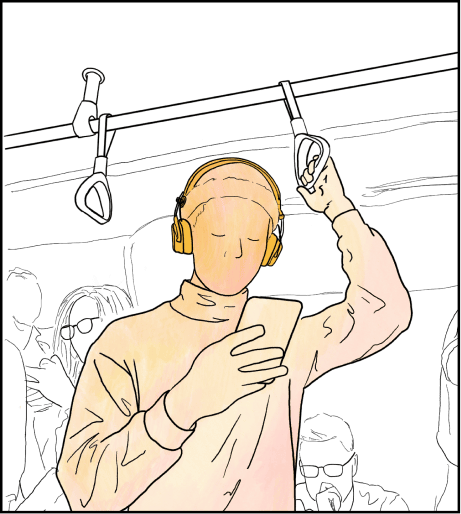
Loudspeakers make sound public by distributing it through a shared space, while headphones make listening private by removing it from that space altogether. Both leave little room for sound that is locally present without either isolating the listener or imposing on everyone nearby.
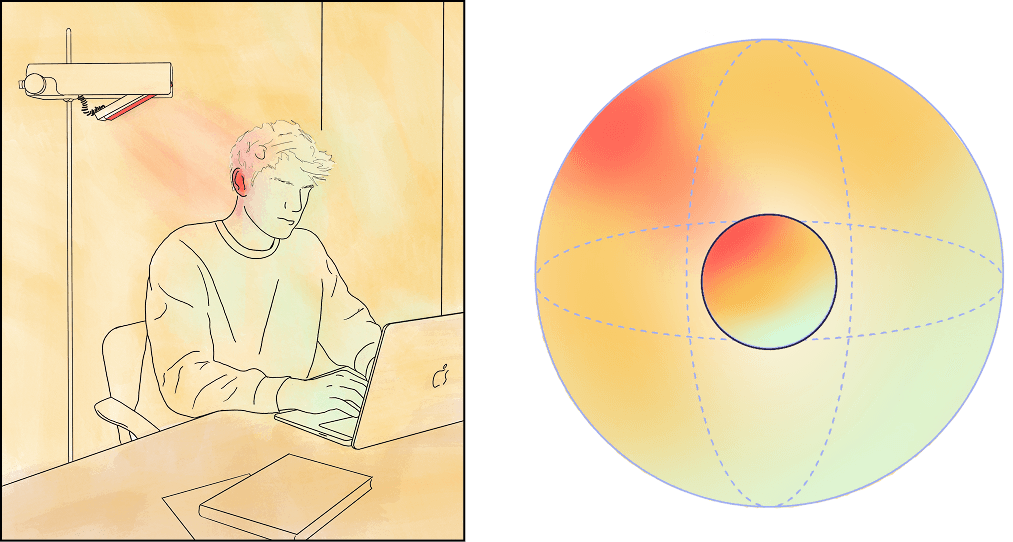
Bounded auditory space asks whether sound can occupy a localized region within a shared environment while the rest of that environment remains perceptually available. The listener can enter, leave, or move around the sound rather than having to withdraw from the surrounding world in order to hear privately.
2. Permeability
Headphones tend to treat music and environment as alternatives. Isolation suppresses the surrounding world; transparency restores it. In either case, the relationship is largely organized around choosing how much of the environment is admitted back into the listening experience.
Permeability asks whether music and environment can instead coexist within one attentional field, with one becoming focal while the other remains present as its grounding fringe. Rather than switching between two listening states, the relationship between them can remain continuous and adjustable.
3. Continuity of Navigation
Streaming gives us immediate access to enormous libraries of music, yet navigation still treats songs as discrete files: skip, stop, replace, begin again. Each action interrupts one musical condition in order to introduce another.
Continuity of navigation asks whether selection can happen within the act of listening rather than interrupting it.Just as attention can move from one instrument to another within a concert without the concert stopping, recorded music might be browsed through gradual transitions that preserve the listener’s orientation while the focal sound changes.
These principles defined the criteria for the prototypes. Their job was to make these questions testable.
The probes had to be functional enough to produce real acoustic contexts that determined whether the intended listening was available at all. Two probes were built to address the three experiential principles.


A BOUNDED FIELD
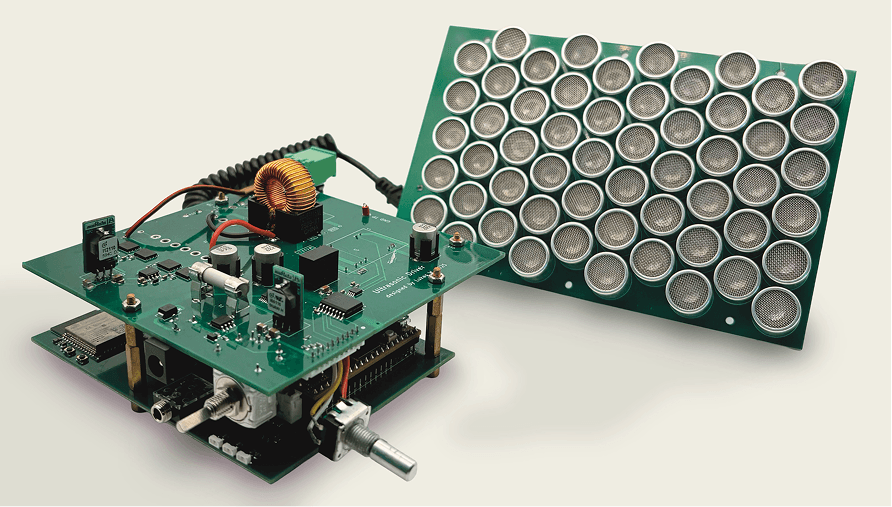
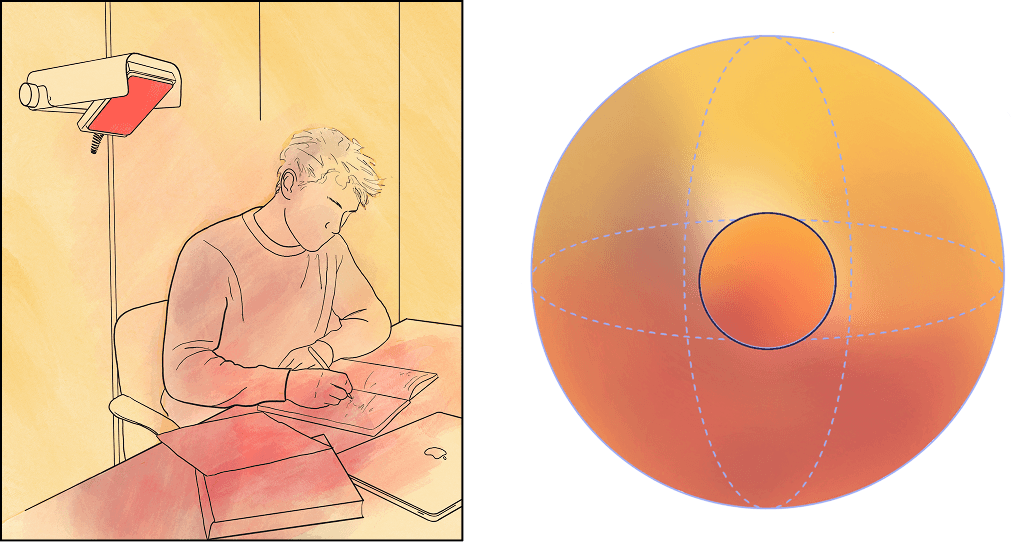
To test bounded auditory space, I needed a probe whose audible presence changed with the listener’s position without requiring headphones. I built a parametric speaker whose ultrasonic beam could be aimed at specific areas of the environment, creating a localized region in which sound became present while the surrounding acoustic world remained available.
The system uses fifty-five 40 kHz piezoelectric transducers driven through a custom PCB integrating a Daisy Seed, ESP32, DAC, and differential H-bridge. Audio is translated into amplitude changes in an ultrasonic carrier and driven through PWM, so carrier frequency, modulation depth, and the resonance of the array jointly affect audible clarity, loudness, and directionality.
I fabricated the enclosure from laminated veneer, 3D-printed structural components, and a milled aluminum base; the finished system supports AUX and Bluetooth playback. I tuned carrier frequency and modulation depth until the directional condition was stable enough to be encountered repeatedly, treating further optimization of intensity and boundary consistency as engineering work beyond what the probe needed to establish.


NAVIGATION AND PERMEABILITY
The personal audio player tested whether recorded music could behave more like a field than a sequence of files. Touching the surface establishes the current track as a center reference; moving left or right brings other songs in as a continuous stream, while distance from center controls whether the listener is comparing the current song against the next or moving more quickly through the library. The current track and preview remain active simultaneously through a staged handoff, so browsing happens within the listening rather than by repeatedly stopping and replacing it.
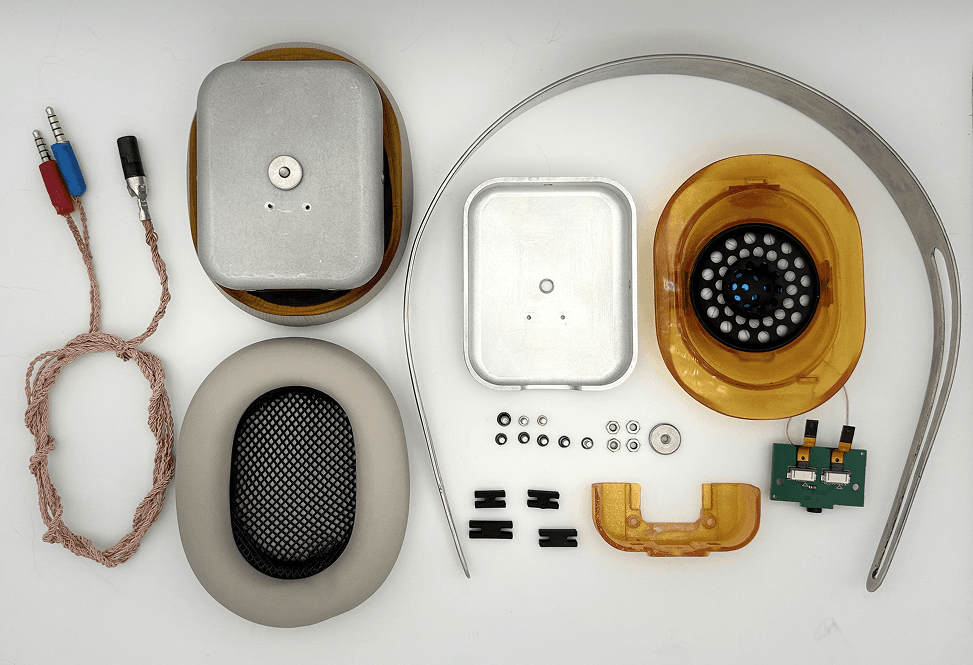
The same system makes the relationship between music and the surrounding environment continuously adjustable. Live input from microphones in the headphones is mixed against playback in real time, and a two-finger vertical gesture moves between music-dominant, environment-dominant, and intermediate states without removing the headphones or switching fixed modes.
I built the playback chain around a Daisy Seed, capacitive touch interface, AK4493 DAC, OPA1656 analog stage, OPA1622 headphone amplifier, and a custom PCB. The player and headphone cups were milled from aluminum and finished by hand; the headband was laser-cut from steel, polished, and rolled into form.
Structured Encounters
The parametric speaker was tested through eight encounters across two settings: five participants used it while working in a shared space, while three kept it at home for a day before being interviewed. The personal audio player was tested separately with eight participants.
Across both probes I gathered first-person descriptions through semi-structured interviews and supported them with observations of movement, posture, and device adjustment. The aim was not to validate finished products, but to see whether the intended listening conditions were reachable and how the principles changed once they had to operate through working artifacts.
PARAMETRIC SPEAKER & BOUNDED AUDITORY SPACE
I expected the boundary to come primarily from the beam itself. Instead, testing showed that the terminating surface determined how the sound was experienced.
When aimed directly toward a listener, the clearest position was a narrow alignment with one ear; participants often searched with small head movements before the sound suddenly came into focus, describing it as if a single headphone were suspended beside the ear. When the beam terminated on a desk or wall, that surface behaved like a quiet localized speaker. The reflected sound reached both ears and was generally described as more natural and comfortable, although less private.
This changed the principle. The probe was not simply showing that sound could become private in public; it was showing how directional sound becomes localized through either the body or the room. The condition participants found most orienting was the one in which sound appeared to belong to a surface in the environment. The surrounding world remained available as the ground of listening while only the apparent source shifted.
PERSONAL AUDIO PLAYER & CONTINUITY OF NAVIGATION
The first navigation model treated the song library as a spatial map, with surrounding tracks expected to approach or recede from different directions.
The encounters exposed a mismatch: stereo recordings already contain their own internal spatial structure, so finger direction could not reliably determine the perceived direction of a song entering or leaving. I redesigned the interaction around what had actually proved meaningful (persistence, preview, and gradual transition) reducing it to the left-right model used in the final probe.
Participants understood the revised interaction through familiar forward-and-back playback habits, but continuity changed the character of those habits. Songs receded, overlapped, and returned rather than simply stopping and starting. The finding was therefore not that music needed to become a fully spatial map, but that navigation could preserve the listener’s orientation to an unfolding musical field. Familiar conventions made the interaction legible; continuity made the experience different.

PERSONAL AUDIO PLAYER & PERMEABILITY
Most participants returned to an intermediate position where music remained dominant and environmental sound receded without disappearing. One described this as “giving the music a place.” In use, the backgrounded sound, whether environment or music, could situate the foregrounded sound rather than compete with it, and moving between them felt like an opening rather than a switch. The principle became more specific: permeability was not a compromise between isolation and transparency, but a distinct figure-ground condition in which the surrounding environment could remain perceptually available while music stayed focal.